Imagine a child who understands maths concepts during class but suddenly freezes when faced with a test or refuses to even open their maths homework at home. For many parents, this situation can be confusing and frustrating. The issue is often not a lack of ability but an emotional response known as maths anxiety. Unlike genuine learning challenges, maths anxiety affects how children think, feel, and perform when they encounter numbers or mathematical tasks. The good news is that it is far more common than many people realise, and with the right support, encouragement, and strategies, children can rebuild their confidence and develop a healthier relationship with maths. In this article, we’ll explore why maths anxiety develops, how to recognise the warning signs, and practical ways parents can help break the cycle.
What Is Maths Anxiety & How Common Is It
Maths anxiety is a feeling of worry, stress, or fear that arises when a child is asked to solve mathematical problems. It goes beyond simply disliking maths or feeling nervous before an exam. Instead, it can interfere with concentration, memory, and problem solving, making even familiar questions seem overwhelming. Importantly, maths anxiety can affect students of all abilities, including those who usually perform well in other subjects.
How Common Is It Among Australian Students
Maths anxiety is becoming increasingly recognised in Australian schools, affecting both primary and secondary students. Many children experience some level of anxiety around maths, yet it often goes unnoticed because it is mistaken for laziness, lack of motivation, or poor study habits. In reality, capable students may avoid maths altogether because the emotional stress associated with it becomes stronger than their confidence in solving problems.
The Root Causes Behind Maths Anxiety In Kids
There is rarely a single explanation for why a child develops maths anxiety. Instead, it is usually the result of several experiences and influences that gradually shape the way they feel about mathematics.
Negative Early Experiences
Early classroom experiences can have a lasting impact on a child’s confidence. Being corrected in front of classmates, struggling through timed tests, or being singled out to answer difficult questions can create embarrassment and self doubt. Over time, these experiences may become some of the primary causes of maths anxiety, making children associate maths with stress rather than learning.
Family & Home Influences
Parents play an important role in shaping their child’s attitude towards learning. Comments such as “I was never good at maths either” may seem harmless, but they can unintentionally reinforce the belief that maths ability is fixed rather than something that improves with practice. Comparing children with siblings or classmates can also increase pressure and contribute to a growing fear of maths, particularly if they begin believing they cannot meet expectations.
Academic Pressure Points
As children progress through school, assessment pressure often increases. Preparing for NAPLAN, selective school entry exams, or school benchmarks can make maths feel like a constant test of ability. At the same time, small gaps in foundational knowledge may accumulate, leaving students struggling with more advanced topics because earlier concepts were never fully understood.
Classroom Environment Factors
Every child learns differently, but classroom settings do not always allow for individual learning needs. A fast teaching pace or large class sizes can make it difficult for teachers to provide personalised support. When students fall behind, they may begin experiencing maths learning difficulties, even when their actual potential is much higher than their classroom performance suggests.
How To Spot The Signs Your Child May Be Struggling
Recognising maths anxiety early allows parents to provide support before confidence declines further. The signs are often subtle and may appear emotionally, physically, or academically.
Physical Signs
Some children complain of headaches, stomach aches, or simply feeling unwell before maths lessons, tutoring sessions, or tests. While these symptoms may seem unrelated, anxiety frequently presents itself through physical discomfort.
Behavioural Signs
Children experiencing maths anxiety may avoid homework, rush through questions without thinking, or give up after encountering the first difficult problem. They may also procrastinate whenever maths tasks are assigned, preferring almost any other activity.
Emotional Signs
Frustration, tears, and negative self talk are common indicators. Statements like “I’m just bad at maths” or “I’ll never get this right” often reflect a loss of confidence rather than actual ability. These emotional responses can become increasingly frequent if the underlying anxiety is not addressed.
Academic Signs
A noticeable drop in maths performance despite steady achievement in other subjects can be an important warning sign. In some cases, children who appear to have difficulties in learning mathematics are actually struggling with anxiety that prevents them from applying the knowledge they already possess.
The Long-Term Impact Of Untreated Maths Anxiety
If maths anxiety continues unchecked, its effects often extend well beyond primary school. Mathematics is a cumulative subject, meaning new concepts build upon earlier ones. When children avoid practising or engaging with maths, learning gaps widen over time, making future topics increasingly difficult to understand.
The impact also reaches beyond academic performance. Students with persistent maths anxiety may avoid advanced maths subjects in secondary school, limiting future study and career opportunities in areas such as science, technology, engineering, and finance. Research has also shown that anxiety itself can reduce mathematical performance independently of actual ability, affecting confidence across other learning areas and shaping a child’s overall attitude towards education.
Practical Ways Parents Can Help Break The Cycle
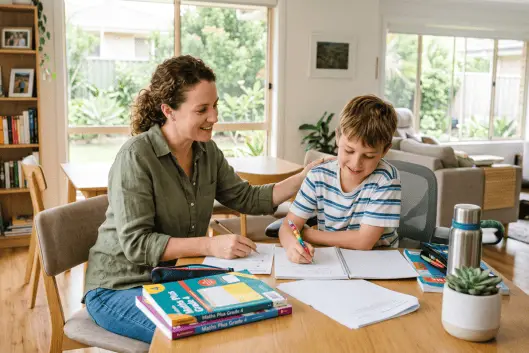
Parents cannot remove every challenge their child will face, but they can create an environment where confidence gradually replaces fear. Small, consistent actions often have a greater impact than dramatic changes.
Reframe Mistakes As Part of Learning
Help your child understand that mistakes are a normal and valuable part of learning. Every incorrect answer provides an opportunity to discover a new strategy or strengthen understanding rather than proving failure.
Watch Your Own Language Around Maths
Children often absorb the attitudes they hear at home. Avoid describing yourself as “bad at maths” or suggesting that mathematical ability is something people are simply born with. Instead, focus on the idea that skills develop through practice and persistence.
Build Confidence Through Everyday Maths
Maths does not have to stay inside a workbook. Everyday activities such as cooking, shopping, budgeting, measuring ingredients, or playing board games provide relaxed opportunities to practise mathematical thinking without the pressure of formal lessons.
Celebrate Effort, Not Just Correct Answers
Rather than praising only perfect results, acknowledge your child’s persistence, willingness to try different approaches, and problem solving process. Recognising effort helps develop resilience and encourages children to continue learning even when tasks become challenging.
When It's Time To Consider Extra Support
Sometimes, despite a parent’s best efforts, home strategies alone may not be enough. If your child continues avoiding maths, experiences ongoing anxiety, or shows little improvement despite regular practice, additional support may be beneficial. Early intervention often prevents confidence from declining further.
A structured learning environment that combines patience, personalised instruction, and concept based teaching can help children rebuild both mathematical understanding and self belief. At GrowthEdge Learning, tutoring focuses not only on improving academic outcomes but also on helping students develop confidence, positive study habits, and a deeper understanding of mathematical concepts at a pace that suits their individual learning needs.
Final Thoughts
Maths anxiety is common, but it does not have to define your child’s learning journey. With understanding, encouragement, and consistent support, children can develop confidence alongside stronger mathematical skills. If your child continues to struggle despite your efforts at home, reaching out for professional guidance can provide the personalised support they need to overcome anxiety and enjoy learning maths again.