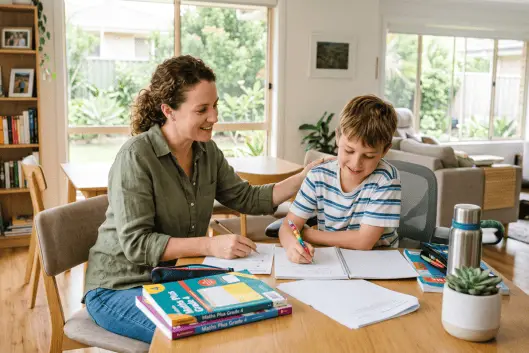
If your child studies their spelling list all week and still misspells the same words on test day, you are not alone. Many parents assume this comes down to a lack of effort, but more often than not, it simply means the usual methods are not working for how your child learns. Struggling with spelling is not a reflection of intelligence or ability. It usually points to a mismatch between the strategy being used and the way a child naturally processes and remembers words.
The encouraging news is that with the right spelling strategies for students, most kids can make real progress. In this blog, we will look at why traditional methods often fall short, how to recognise the signs of a struggling speller, and a range of practical, easy to apply techniques you can start using at home straight away.
Why Traditional Spelling Methods Don't Work For Every Child
Traditional spelling instruction tends to rely heavily on repetition and visual memory, writing a word out ten times, or looking at a list until it sinks in. This approach works well for some children, but not all. For many students, especially those who process information differently, memorising the shape of a word without understanding its structure simply does not stick.
Spelling lists and repetition alone also do not address the underlying skills a child needs to spell accurately and independently, such as recognising sounds, patterns and word families. Without these foundations, spelling can feel like guesswork rather than something a child can reason through.
Understanding Different Learning Styles
Children generally lean toward visual, auditory or kinaesthetic learning styles, or a combination of all three. A visual learner might benefit from seeing a word broken into colour coded syllables, while an auditory learner may need to hear and say a word aloud to remember it. A kinaesthetic learner often needs movement or hands on activities to make spelling stick. This is exactly why a single, one size fits all approach leaves so many children behind, and why varied spelling tips for students tend to work far better than a single method used in isolation.
Common Signs Your Child Is Struggling With Spelling
It is not always obvious when a child is genuinely struggling versus simply needing more practice. A few common signs to watch for include:
- Frequently misspelling the same words, even after repeated practice
- Avoiding writing tasks or becoming frustrated during spelling homework
- Relying heavily on spell check or constantly asking how words are spelled
- A strong verbal vocabulary that does not match their written spelling ability
If several of these sound familiar, it may be time to try a different approach rather than simply doing more of the same.
Phonics-Based Strategies To Build Stronger Foundations
Phonics-based learning is one of the most effective spelling strategies for struggling students, because it teaches children to understand how words are built rather than memorising them as a whole.
Breaking Words Into Sounds
Encourage your child to sound out words syllable by syllable instead of trying to memorise them all at once. Breaking a longer word like “elephant” into “el, e, phant” makes it far less overwhelming and easier to spell correctly.
Recognising Letter Sound Relationships
Reinforcing common phonics patterns and letter blends helps children predict spelling more accurately, even for words they have not seen before. Once a child understands that “sh” makes one sound or that a silent “e” changes a vowel sound, they can apply that rule across many different words.
Multi-Sensory Techniques That Make Spelling Stick
Multi-sensory learning combines sight, sound, touch and movement, which helps reinforce memory in children who find traditional methods difficult.
Tracing & Writing In Different Textures
Writing words in sand, using chalk on pavement, or tracing letters in shaving cream can make spelling practice more engaging while reinforcing letter formation in a way that feels less like schoolwork.
Saying Words Aloud While Spelling
Combining auditory and verbal cues, such as saying each letter aloud while writing it, helps strengthen recall by engaging more than one sense at a time.
Using Movement & Rhythm
Clapping out syllables, jumping on each letter, or turning spelling into a rhythm or chant can make words easier to remember, particularly for kinaesthetic learners who need to move to learn.
Using Word Patterns & Common Rules To Simplify Learning
Rather than treating every word as a separate challenge, grouping words by pattern can make spelling feel far more manageable.
Grouping Words By Pattern
Teaching families of words that follow the same rule, such as “night, light, right, sight”, helps children see spelling as logical rather than random. Once they understand the pattern, they can apply it to new words independently.
Simple Spelling Practice You Can Do At Home
Consistent, low pressure practice at home makes a significant difference over time. A few ideas to try include:
- Turning spelling practice into short games rather than formal drills
- Using everyday reading and writing to reinforce words in context
- Encouraging your child to create their own memory tricks or mnemonics for tricky words
- Keeping practice sessions short and frequent rather than long and infrequent
Small, regular efforts tend to build far more lasting progress than occasional, lengthy study sessions.
Final Thoughts
Struggling with spelling is more common than most parents realise, and with the right support, it is very manageable. By moving beyond rote memorisation and introducing phonics based, multi sensory and pattern based spelling strategies for students, you can help your child build both their skills and their confidence.
If your child continues to struggle despite trying these strategies at home, GrowthEdge Learning is here to help with tailored, one-on-one support designed around how your child learns best. Call us now to find out more.